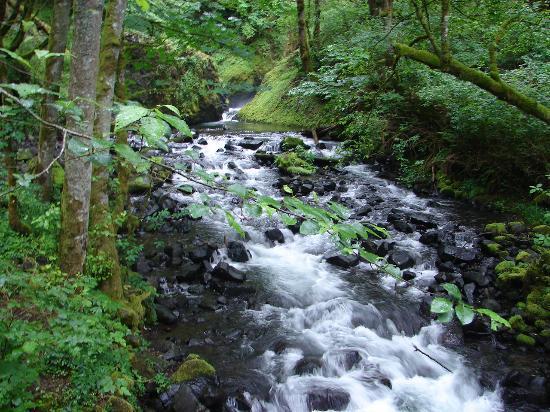


The Kalamazoo River drains an extensive watershed in the southwest portion of the lower peninsula of Michigan. The river flows in a westerly direction and discharges into
Lake Michigan 
near the town of Saugatuck. The upstream boundary of the
Area of Concern (AOC) is Morrow Dam, which forms Morrow Pond, and the AOC extends downstream to Lake Michigan, a distance of approximately eighty miles. The city of Kalamazoo is situated along the AOC reach, and the city of Battle Creek is not far upstream. The Calkins Dam forms a reservoir of 1,600 acres (Lake Allegan) between Kalamazoo and Lake Michigan that traps most sediments and associated contaminants transported by the river. Between Morrow Dam and Lake Allegan are several smaller, decommissioned hydroelectric dams that are partially removed but may soon require further removal or repair due to their decrepit state. The dam removal effort will be complicated by the contaminated sediments trapped behind the dams.
he Remedial Action Plan (RAP) process identified eight of the
Great Lakes Water Quality Agreement's 14 beneficial uses as being impaired. Beneficial use impairments in the AOC include Restrictions on Fish & Wildlife Consumption, Degradation of Fish and Wildlife Populations, Bird or Animal Deformities or Reproductive Problems, Degradation of Benthos, Restrictions on Dredging Activities, Beach Closings, Degradation of Aesthetics, and Loss of Fish and Wildlife Habitat. More details on these impairments, including a list of information sources, can be found in the
Kalamazoo River Remedial Action Plan (RAP) (http://www.glc.org/spac/rapdocs.html)
The Kalamazoo River was listed as an AOC due to historic releases of polychlorinated biphenyls (PCBs), which originated primarily from de-inking operations at local paper mills. The Kalamazoo River has been identified as a site of environmental contamination pursuant to the Michigan Natural Resources and Environmental Protection Act 451 and is included in the Comprehensive Environmental Response, Compensation and Liability Act (CERCLA), commonly known as Superfund.
Kalamazoo River priorities include remediation of PCB contaminated sediments in the river and in floodplain sites along the river, control of nonpoint source pollution (particularly phosphorus), and habitat restoration.
Additionally, since the PCB contamination was identified as a problem in 1971, several actions have been taken to improve conditions within the AOC including the following:
- The discharge of PCBs has been substantially reduced due to the ban on PCB production and other regulatory point source controls, such as the NPDES permit program. However, in-place contaminated sediments in the upstream areas remain a source of PCBs to the Kalamazoo River. The U.S. EPA Region 5 Emergency Response Branch has remediated the Bryant Mill Pond site on Portage Creek to protect the creek from receiving PCBs from the former mill pond.
- Since 1996, some progress has been made on remedial design and remedial action at several Operable Units (OUs) along the river, including the 12th St Landfill OU, Allied Paper Inc. OU, Willow Blvd/A Site OU, and the King Highway Landfill OU.
- Sheet steel piling was installed at contaminated landfill sites along the Kalamazoo River to slow erosion of PCBs into the river. The understanding is that the pilings would be an interim measure at the Willow site and a permanent measure at the Kings Highway Operable Unit. A decision has not been reached yet related to OU 1, but it is anticipated that the sheet piling will become a permanent part of the OU 1 remedy. Decisions on the remediation of this Superfund Site have effectively been on hold for the past several years.
- Records of Decision (RODs) for the remaining Superfund operable units are needed for remedial work to move ahead. Progress towards these has been delayed and ongoing discussions among government agencies and potentially responsible parties have been conducted out of public view.
- In addition, decisions on remediation of in-stream sediment contamination await the results of new modeling efforts currently being sponsored by the U.S. EPA. The modeling will lead to better understanding of hydrology and sediment dynamics and how they bear on PCB remediation options in the affected river reaches.
- The problem of the aging smaller dams and the contaminated sediments behind them has yet to be resolved, but must soon be because several of these dams were deemed to be unstable in recent dam safety inspections.
- The KRWC and other local groups continue to develop and distribute educational materials about the river, including its positive features as well as its problems, and actions that people can take to protect water quality and public health throughout the watershed.
- Watershed management projects in several sub-basins are working to reduce pollutant inputs and develop beneficial land use measures as well as to foster greater understanding of the problem among the public and local governments.
- Stormwater management plans and projects are underway in both Kalamazoo and Battle Creek.
- A phosphorus TMDL (Total Maximum Daily Load) for Lake Allegan and the river upstream of this reservoir has been established, and measures are being implemented to reduce phosphorus pollution from point and nonpoint sources and to involve diverse stakeholders. Significant phosphorus reductions have been achieved.


