Kamis, 30 April 2009

BALI


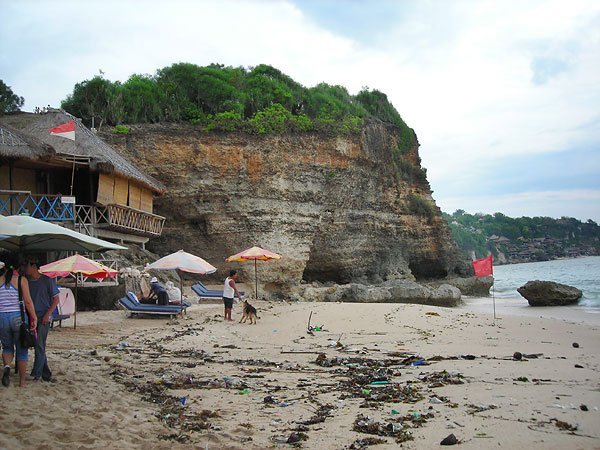
I didn’t know until now that Bali is blessed with some internationally competitive beaches. Due to its natures of its volcano origin, most popular beaches in Bali are of black or gray sand with sandy waters with either no waves at all or strong currents, making it a strange experience when swimming there.
The only almost-white beaches I knew so far were Nusa Dua and Sanur, both either very shallow or with almost no waves and lots of dirt and old plastic bags in the water. Kuta/Legian is nice to swim at, but the sand is gray and you really have to watch out for rip-currents or waves that can drag you out to sea. Every few weeks tourists or locals alike drown here, most recently 3 Balinese school boys around 12-14 years of age.

Kamis, 23 April 2009

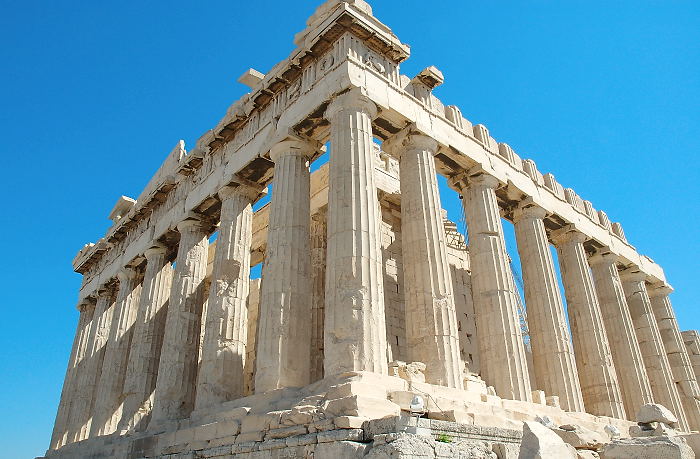
Acropolis of Athens


While the earliest artifacts date to the Middle Neolithic era, there have been documented habitations in Attica from the Early Neolithic (6th millennium BC). There is little doubt that a Mycenaean megaron stood upon the hill during the late Bronze Age. Nothing of this megaron survives except, probably, a single limestone column-base and pieces of several sandstone steps. Soon after the palace was built a Cyclopean massive circuit wall was built, 760 meters long, up to 10 meters high, and ranging from 3.5 to 6 meters thick. This wall would serve as the main defense for the acropolis until the fifth century. The wall consisted of two parapets built with large stone blocks and cemented with an earth mortar called emplekton. The wall follows typical Mycenaean convention in that it followed the natural contour of the terrain and its gate was arranged obliquely, with a parapet and tower overhanging the incomers' right-hand side, thus facilitating defense. There were two lesser approaches up the hill on its north side, consisting of steep, narrow flights of steps cut in the rock. Homer is assumed to refer to this fortification when he mentions the "strong-built House of Erechtheus" (Odyssey 7.81). At some point before the thirteenth century an earthquake caused a fissure near the northeastern edge of the acropolis. This fissure extended some thirty five meters to a bed of soft marl in which a well was dug. An elaborate set of stairs was built and the well was used as a protected source of drinking water during some portion of the Mycenaean period, as it was invaluable in times of siege.

Machu Picchu


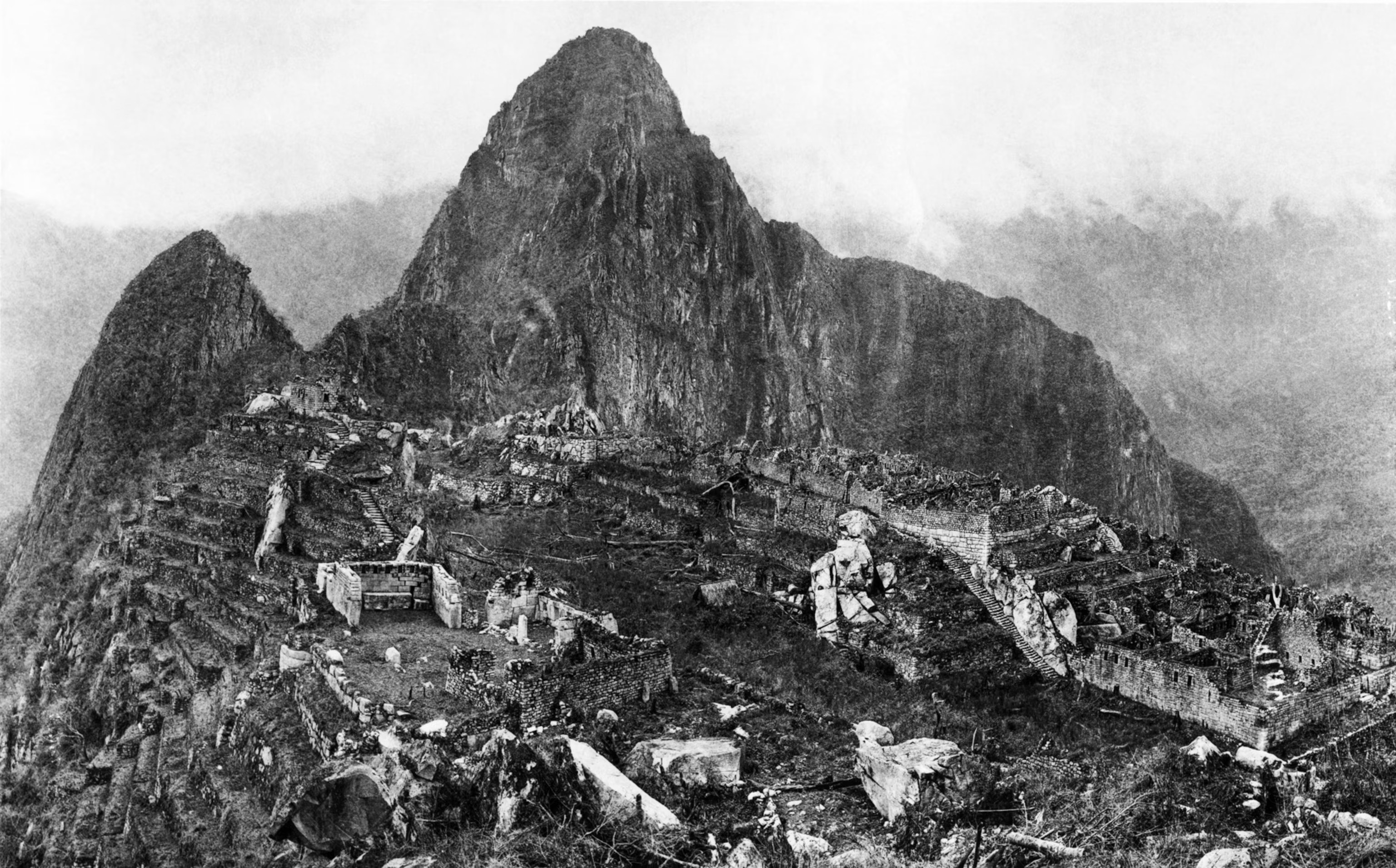
Machu Picchu was constructed around 1462, at the height of the Inca Empire. It was abandoned less than 100 years later. It is likely that most of its inhabitants were wiped out by smallpox before the Spanish conquistadores arrived in the area, and there is no record of their having known of the remote city. Hiram Bingham, the credited discoverer of the site, along with several others, originally hypothesized that the citadel was the traditional birthplace of the Inca of the "Virgins of the Suns".

Another theory maintains that Machu Picchu was an Inca "llacta", a settlement built to control the economy of these conquered regions. Yet another asserts that it may have been built as a prison for a select few who had committed heinous crimes against Inca society. Research conducted by scholars, such as John Rowe and Richard Burger, has convinced most archaeologists that rather than a defensive retreat, Machu Picchu was an estate of the Inca emperor, Pachacuti. In addition, Johan Reinhard presented evidence that the site was selected because of its position relative to sacred landscape features—such as its mountains, which are purported to be in alignment with key astronomical events that would have been important to the Incas.
Although the citadel is located only about 80 kilometers (50 miles) from Cusco, the Inca capital, it was never found by the Spanish and consequently not plundered and destroyed, as was the case with many other Inca sites. Over the centuries, the surrounding jungle grew over much of the site, and few knew of its existence. On July 24, 1911, Machu Picchu was brought to the attention of scholars by Hiram Bingham, an American historian employed as a lecturer at Yale University. Bingham was led up to Machu Picchu by a local 11 year old Quechua boy named Pablito Alvarez. Bingham undertook archaeological studies and completed a survey of the area. Bingham coined the name "The Lost City of the Incas", which was the title of his first book.

Bingham had been searching for the city of Vilcapampa, the last Inca refuge and spot of resistance during the Spanish conquest of Peru. In 1911, after years of previous trips and explorations around the zone, he was led to the citadel by Quechuans. These people were living in Machu Picchu, in the original Inca infrastructure. Although most of the original inhabitants had died within a century of the city's construction, a small number of families survived so by the time the site was 'discovered' in 1911, people still were living on the site, and many mummies—mostly of women—were discovered as well. Bingham made several more trips and conducted excavations on the site through 1915, carrying off artifacts. He wrote a number of books and articles about the discovery of Machu Picchu in his lifetime.

Simone Waisbard, a long-time researcher of Cusco, claims that Enrique Palma, Gabino Sánchez, and Agustín Lizárraga left their names engraved on one of the rocks at Machu Picchu on July 14, 1901. This would mean that they 'discovered' it long before Bingham did in 1911. Likewise, in 1904, an engineer named Franklin supposedly spotted the ruins from a distant mountain. He told Thomas Payne, an English Christian missionary living in the region, about the site, Payne's family members claim. They also report that in 1906, Payne and another fellow missionary named Stuart E McNairn (1867–1956) climbed up to the ruins.

The site received significant publicity after the National Geographic Society devoted their entire April 1913 issue to Machu Picchu.

An area of 325.92 square kilometers surrounding Machu Picchu was declared a "Historical Sanctuary" of Peru in 1981. In addition to the ruins, this sanctuary area includes a large portion of adjoining region, rich with flora and fauna.

Machu Picchu was designated as a World Heritage Site in 1983 when it was described as "an absolute masterpiece of architecture and a unique testimony to the Inca civilization".

On July 7, 2007, Machu Picchu was voted as one of New Open World Corporation's New Seven Wonders of the World. The World Monuments Fund placed Machu Picchu on its 2008 Watch List of the 100 Most Endangered Sites in the world because of environmental degradation resulting from the impact of tourism, uncontrolled development in the nearby town of Aguas Calientes that included a poorly sited tram to ease visitor access, and the construction of a bridge across the Vilcanota River that is likely to bring even more tourists to the site in defiance of a court order and government protests against it.
Jumat, 03 April 2009

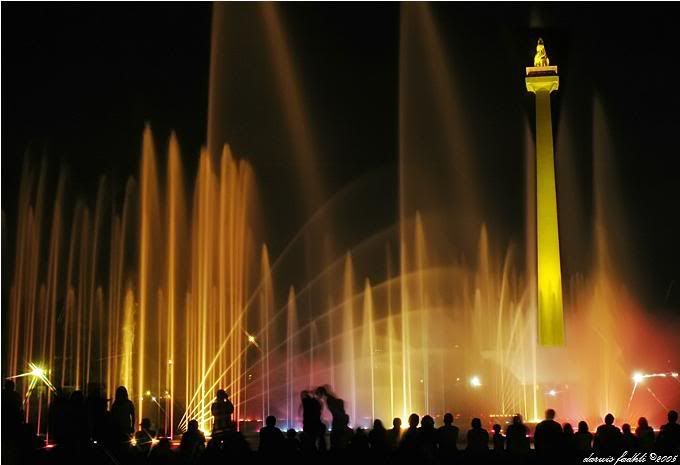
monument of monas.


The design of the monument is meant to combine elements of masculine and feminine. The design based on Lingga-Yoni, the symbol of fertility in ancient Hindu-Javanese belief. The phallic shaft comes toward the ground and is engulfed by square base meant to symbolize fertility. The monument body was made of steel and concrete covered with Italian white marble. On the top of the tower there's a square terrace that can be reach by visitors by elevator. From here visitors can see an aerial view of Jakarta. The monument is crowned by gold-coated flame, right on the top of the peak terrace. This golden flame is intended to symbolize the spirit of freedom and the struggle for independence of Indonesian people

coast of bali.


Bali is one of the most visited vacation hotspots in the world. Situated in Indonesia, it was once named as the best island destination in the world by Travel and Leisure magazine. It attracts huge number of travelers from all over the world with its fun filled, palm fringed beaches known for having white sand. Bali has a many beaches, all of which are easily reachable from Despansar airport.

The line of beaches on the island of Bali includes Sanur beach, Jimbaran, Soka beach, Nusa Dua, Medewi beach, Lovina beach, Kuta, and Legian beach. Locals and tourists popularly go after Legian beaches, which are famous for their magnificent view of sunset. Surfing is a major activity here and the best waves are a 5 to 10 minute drive from Despansar airport.

Mountain of Himalaya


Cho Oyu, which means “The Turquoise Goddess” is known as the sixth highest mountain in the world, located a short distance to the west from the world's highest mountain, the Everest and the fourth highest, the Lhotse in the Khumbu region of Eastern Nepal along the Tibetan border. Its one of the towering peak that stands with Everest well above the surrounding mountains. Cho Oyu became a familiar landmark to climbers ascending Everest's north face.

Just west of Cho Oyu is the Nangpa La, a 19,000-foot glacier pass, the main trade route between the Khumbu Sherpas and Tibet. Cho Oyu's proximity to the Nangpa La has earned it the distinction among some climbers as being the easiest 8,000 meter peak. It was the third such peak climbed, and the first climbed in Autumn. It was first climbed on October 19th 1954 by the Austrian Herbert Tichy, with Sepp Jochler and Pasang Dava Lama.

Rabu, 01 April 2009

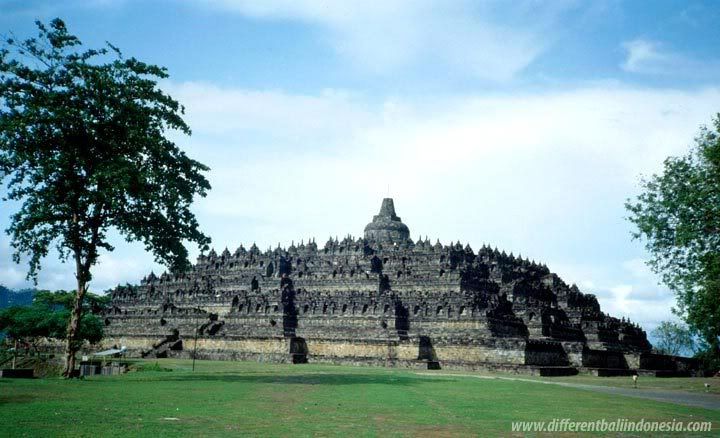
tourism to temple of borobudur.


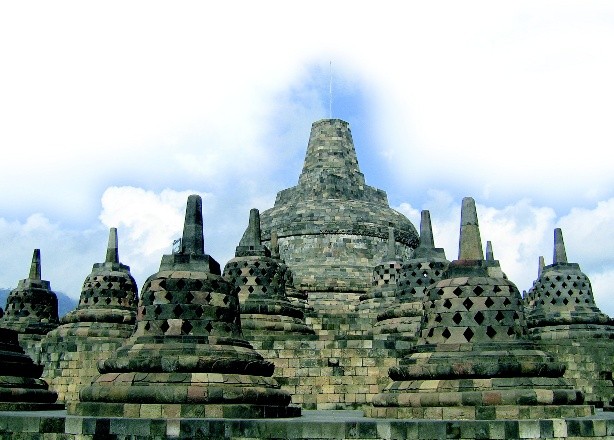
Borobudur is a ninth-century Mahayana Buddhist monument in Magelang, Central Java, Indonesia. The monument comprises six square platforms topped by three circular platforms, and is decorated with 2,672 relief panels and 504 Buddha statues.A main dome, located at the center of the top platform, is surrounded by 72 Buddha statues seated inside perforated stupa.

The monument is both a shrine to the Lord Buddha and a place for Buddhist pilgrimage. The journey for pilgrims begins at the base of the monument and follows a path circumambulating the monument while ascending to the top through the three levels of Buddhist cosmology, namely Kāmadhātu (the world of desire), Rupadhatu (the world of forms) and Arupadhatu (the world of formlessness). During the journey the monument guides the pilgrims through a system of stairways and corridors with 1,460 narrative relief panels on the wall and the balustrades.

Evidence suggests Borobudur was abandoned following the fourteenth century decline of Buddhist and Hindu kingdoms in Java, and the Javanese conversion to Islam.Worldwide knowledge of its existence was sparked in 1814 by Sir Thomas Stamford Raffles, the then British ruler of Java, who was advised of its location by native Indonesians. Borobudur has since been preserved through several restorations. The largest restoration project was undertaken between 1975 and 1982 by the Indonesian government and UNESCO, following which the monument was listed as a UNESCO World Heritage Site.Borobudur is still used for pilgrimage; once a year Buddhists in Indonesia celebrate Vesak at the monument, and Borobudur is Indonesia's single most visited tourist attraction.