Jumat, 04 Desember 2009

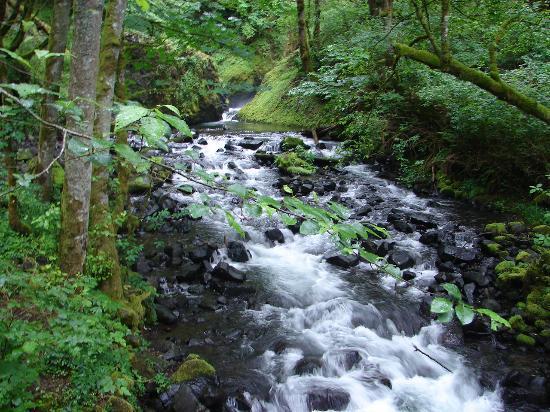
Kouang Si Waterfalls, Laos


When I told the official, he actually told me to walk through customs (leaving my passport as collateral) and into the airport forecourt where I could change my various notes to US dollars at the money exchange and then come back and go through immigration - how bizarre. At the money exchange (no cash machines in Luang Prabang airport), I managed to muster $30 from my Vietnamese Dong and Thai Baht and by trading my tenner, I'd make it; however, the woman was having none of my "Royal Bank of Scotland" Sterling note. "No have lady, no have lady" said she, stabbing my tenner with her finger, totally unconvinced of my explanation that Sterling is Sterling. "I show you lady." to which I replied "Yes, I know what Queen Elizabeth looks like thank you very much." In desperation, I even resorted to the words that are spoken by thousands of people across SE Asia at any given moment in time to explain anything and everything: "Same, Same... but different" and at that point I realised I was getting nowhere. Actually, if anything, I was closer to being sent back on the next flight to Hanoi.

Rabu, 02 Desember 2009

World’s Most Amazing Waterfalls


Waterfalls are one of nature’s most beautiful creations, and come in all shapes in sizes. They are usually judged by their height, width or style or volume of water. Styles of waterfalls include tiered, cascades, horsetails or single drops (plunges). Some larger waterfalls contain multiple styles, showcasing cascades, tiers and even horsetails in one amazing waterfall.

With thousands of waterfalls across the world, it is difficult to choose the best – but our list contains what we believe of the world’s most amazing and beautiful ones!

rivers


The Kalamazoo River drains an extensive watershed in the southwest portion of the lower peninsula of Michigan. The river flows in a westerly direction and discharges into Lake Michigan Exit disclaimer near the town of Saugatuck. The upstream boundary of the Area of Concern (AOC) is Morrow Dam, which forms Morrow Pond, and the AOC extends downstream to Lake Michigan, a distance of approximately eighty miles. The city of Kalamazoo is situated along the AOC reach, and the city of Battle Creek is not far upstream. The Calkins Dam forms a reservoir of 1,600 acres (Lake Allegan) between Kalamazoo and Lake Michigan that traps most sediments and associated contaminants transported by the river. Between Morrow Dam and Lake Allegan are several smaller, decommissioned hydroelectric dams that are partially removed but may soon require further removal or repair due to their decrepit state. The dam removal effort will be complicated by the contaminated sediments trapped behind the dams.

he Remedial Action Plan (RAP) process identified eight of the Great Lakes Water Quality Agreement's 14 beneficial uses as being impaired. Beneficial use impairments in the AOC include Restrictions on Fish & Wildlife Consumption, Degradation of Fish and Wildlife Populations, Bird or Animal Deformities or Reproductive Problems, Degradation of Benthos, Restrictions on Dredging Activities, Beach Closings, Degradation of Aesthetics, and Loss of Fish and Wildlife Habitat. More details on these impairments, including a list of information sources, can be found in the Kalamazoo River Remedial Action Plan (RAP) (http://www.glc.org/spac/rapdocs.html) Exit disclaimer

The Kalamazoo River was listed as an AOC due to historic releases of polychlorinated biphenyls (PCBs), which originated primarily from de-inking operations at local paper mills. The Kalamazoo River has been identified as a site of environmental contamination pursuant to the Michigan Natural Resources and Environmental Protection Act 451 and is included in the Comprehensive Environmental Response, Compensation and Liability Act (CERCLA), commonly known as Superfund.

Kalamazoo River priorities include remediation of PCB contaminated sediments in the river and in floodplain sites along the river, control of nonpoint source pollution (particularly phosphorus), and habitat restoration.

Additionally, since the PCB contamination was identified as a problem in 1971, several actions have been taken to improve conditions within the AOC including the following:

  • The discharge of PCBs has been substantially reduced due to the ban on PCB production and other regulatory point source controls, such as the NPDES permit program. However, in-place contaminated sediments in the upstream areas remain a source of PCBs to the Kalamazoo River. The U.S. EPA Region 5 Emergency Response Branch has remediated the Bryant Mill Pond site on Portage Creek to protect the creek from receiving PCBs from the former mill pond.
  • Since 1996, some progress has been made on remedial design and remedial action at several Operable Units (OUs) along the river, including the 12th St Landfill OU, Allied Paper Inc. OU, Willow Blvd/A Site OU, and the King Highway Landfill OU.
  • Sheet steel piling was installed at contaminated landfill sites along the Kalamazoo River to slow erosion of PCBs into the river. The understanding is that the pilings would be an interim measure at the Willow site and a permanent measure at the Kings Highway Operable Unit. A decision has not been reached yet related to OU 1, but it is anticipated that the sheet piling will become a permanent part of the OU 1 remedy. Decisions on the remediation of this Superfund Site have effectively been on hold for the past several years.
    • Records of Decision (RODs) for the remaining Superfund operable units are needed for remedial work to move ahead. Progress towards these has been delayed and ongoing discussions among government agencies and potentially responsible parties have been conducted out of public view.
    • In addition, decisions on remediation of in-stream sediment contamination await the results of new modeling efforts currently being sponsored by the U.S. EPA. The modeling will lead to better understanding of hydrology and sediment dynamics and how they bear on PCB remediation options in the affected river reaches.
    • The problem of the aging smaller dams and the contaminated sediments behind them has yet to be resolved, but must soon be because several of these dams were deemed to be unstable in recent dam safety inspections.
  • The KRWC and other local groups continue to develop and distribute educational materials about the river, including its positive features as well as its problems, and actions that people can take to protect water quality and public health throughout the watershed.
  • Watershed management projects in several sub-basins are working to reduce pollutant inputs and develop beneficial land use measures as well as to foster greater understanding of the problem among the public and local governments.
  • Stormwater management plans and projects are underway in both Kalamazoo and Battle Creek.
  • A phosphorus TMDL (Total Maximum Daily Load) for Lake Allegan and the river upstream of this reservoir has been established, and measures are being implemented to reduce phosphorus pollution from point and nonpoint sources and to involve diverse stakeholders. Significant phosphorus reductions have been achieved.

River Words


After much discussion, the judges awarded Brendan and Christina O'Conner the grand prize of the Samsung digital camera for their stunning photo of Lake Matheson near the Fox Glacier on the West Coast. The four runners up also captured outstanding photos of New Zealand.
In our work as a river conservation organization, we often deal with that element of rivers you'd call the "working river," the river that transports goods, generates electrical power, conveys waste water, and irrigates crops. That facet of a river brings out the technocratic in us -- we need to know it like a nurse needs to know her patient, measuring flow and pollution load and oxygen levels. And we strive mightily to get the right classifiication for this river, or get that river off a bad list.

But there's the soulful side of rivers, the side that brings on reflection, joy, sweet memories, and meaningful action. As we ask people about their "home river," most everyone can pull up a memory or an inspiring moment spent by a river.

"River Words" is designed to display and capture those memories and inspiring moments. We encourage you to take inspiration from these stories, and feel inspired to add your own story -- about one of the rivers described here, or another one that you call your "home river."

Send your River Words essay to info@wisconsinrivers.org. Keep it under 500 words, and please include a digital photo of yourself on, in, or near your river if you have some. Identify yourself and your home town.
River Alliance reserves the right to edit the essays for length and content.

Senin, 13 Juli 2009

Floating in the Dead Sea


Increasing popularity of spa vacations as people lead healthier lifestyles has seen the world-renowned Dead Sea coast become a major Jordan tourism destination. The natural healing power of the Dead Sea Jordan is world renowned for its rejuvenating Dead Sea minerals and spectacular landscape.

The healing properties of the Dead Sea Jordan are believed to have attracted visitors since ancient times including King Herod the Great and Egyptian Queen Cleopatra. Its popularity is no different today with widely publicized Dead Sea facts promoting the health benefits of the region.

The Dead Sea at 410 meters below sea level is the lowest place on earth. Famed for having an exceptionally high salt content, the sea is largely devoid of plant and animal life. The high salt content of the seawater allows a literally buoyant experience as visitors can stretch out and bath without sinking. The warm temperate climate and high oxygen atmosphere of the Dead Sea region has even been shown to aid the recuperation of heart surgery patients.

The Dead Sea Jordan boasts a dramatically beautiful rugged landscape that forever attracts international visitors to the region. Washed up along the rocks of the Dead Sea shoreline are huge salt crystals, which look at first glance like snow.

With significant investment in the area, new luxurious resorts and hotels near Dead Sea are continually popping up. Lavish 5 star hotel resorts and spas line the coast offering modern facilities, exotic cuisine and complete luxury from which to branch out and explore the fascinating landscape. Hotels near Dead Sea have first-rate facilities offering spas, massages and fitness centers. Many also have well manicured private beaches. All aim to provide the visitor with a unique and relaxing experience. The hotels spa pools also offer the perfect setting from which to view the sunset over the Dead Sea.

Dead Sea facts are often well publicized and account for 21 Dead Sea minerals that can be found within the seawater. Impressively 12 of these minerals are exclusively Dead Sea minerals and cannot be found in any other water in the world. High levels of Dead Sea minerals to be found in the water include magnesium, sodium, potassium and bromine.

A world renowned place to rejuvenate body and soul with a mud bath, studies have shown that the rich thick black mud found along the shoreline has significant health benefits. Published Dead Sea facts site these benefits as including increased circulation, easing arthritis pain, healing allergies and revitalizing the body’s skin. The mud or pelloid is routinely used in spa treatments as it has been found to retain heat exceptionally well. Smeared onto the body, the mud has been found to cleanse the skin and relieve rheumatic pain.

A bonus for visitors to the Dead Sea Jordan is the nearby natural wonder of the Hammamat Ma’in hot springs. Both locals and tourists flock to this beautiful oasis to enjoy the mineral rich and hyper-thermal waterfalls. Underground lava fissures naturally heat the water. The hot springs are complemented by the nearby Janna Spa and Resort, which offers a variety of massages, beauty treatments, mud facials and mud wrapping.

For those unable to afford 5 star luxuries, there are plenty of hotels near Dead Sea close to Amman. Just outside of the main Dead Sea hotel zone is the Amman Touristic beach with swimming pools and changing rooms. It offers a more affordable area for lower budget travelers to stay and a good location particularly if you want to explore the historic sites of Amman.

Bunaken National Park


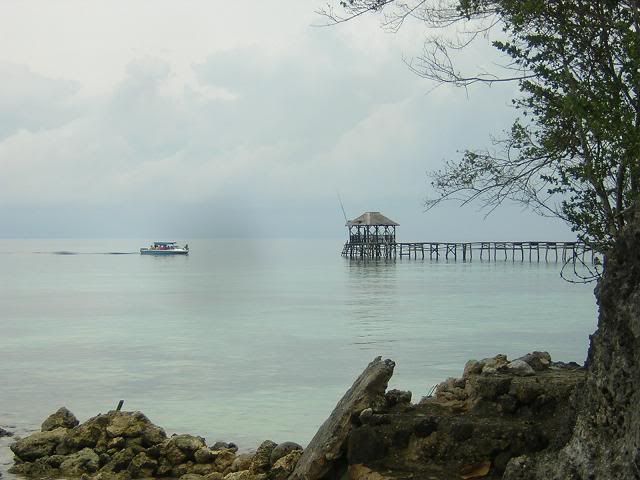
flat island about 15 km from Manado, with a friendly people. The coral reefs off Bunaken island shouldn't be missed while you are in Manado. These magnificent virgin reefs are still relatively unspoiled. The drop-off walls at Liang cove is not only rare in the world, with caves, gullies and caverns, harboring an immense wealth of marine life. Spectacular formation of reefs begin with flat at about 5 m depth. These plunge downward to form underwater vertical crevices with often reach depth on several hundred meters. On these beautiful reefs, a wonderful collection of marine life thrives.

The Bunaken reef is a chain of over 40 five star dive spots. The Marine Park is spectacular with the greatest concentration of tropical fish, coral species and world famous wall diving.
Clear, warm waters (sea temperatures usually range between 27-30 degrees C), light currents and calm seas allow easy access to the underwater attraction awaiting visitors to the five-islands of the Bunaken-Manado Tua National Marine Park which sits directly offshore of Manado. Bunaken is the standout favorite, with the highest density of schooling fish and the greatest probability to see larger species such as turtles, sharks, and napoleon wrasse. There are enough sites here to keep any diver happy for over a week without going elsewhere.

The Dive Sites :
Most diving takes place near Bunaken and Manado Tua, because of their many excellent sites. The following is representative of the diving in the area.

  • Lekuan Walls (I, II, III)
    This long wall on Bunaken is divided into three sites: Lekuan I, II and III. Together they represent the park's best. Steep walls are marked with deep crevices, sea fans and giant sponges. The shallows are filled with fishes. The wall, often protected from stronger currents, is frequented by bumphead parrotfish, turtles, and Napoleon wrasses.
  • Mandolin
    Mandolin has a knockout reef crest and a wall that attracts thousands of fishes like schooling fusiliers, surgeonfish, unicornfish, and bannerfish. They are acclimated to divers and are easily approachable.
  • Bunaken Timor
    There are strong currents and lots of fishes on this long wall. The shallow reef isn't as spectacular as some but there are turtles, sharks, eagle rays, and other big fishes in the blue. Overhangs and small caves mark the wall.
  • Tanjung Kopi
    Tanjung Kopi is a nice wall with a small school of barracuda and lots of sweetlips. Visibility in the shallows is not terrific but the numbers of fishes make up for it. Nudibranches and fire gobies are easy to spot here.
  • Siladen Island
    Siladen has a beautiful wall of soft corals that bloom when the current is running. The shallows are nice with lots of fishes and schooling snappers.
  • Muka Gereja
    Muka Gereja is a pretty site with thousands of fishes in the shallows and deeper canyons that lead to the wall.
  • Barracuda Point
    Barracuda Point, on northwest Montehage, is one of the furthest sites. A school of giant barracuda are regulars along with jacks and tuna.
  • Manado Wreck
    This 60m (200ft) long German merchant ship sank near Molas Beach in 1942. It sits upright with the bow at 23m (78ft). The ship is split near amidships back to the stern, exposing the wheelhouse and cargo holds. Dives finish up on a nearby shallow reef. Expect 10-15m (30-50ft) visibility.


Mount Rinjani Enchanting, Tourist Increasing


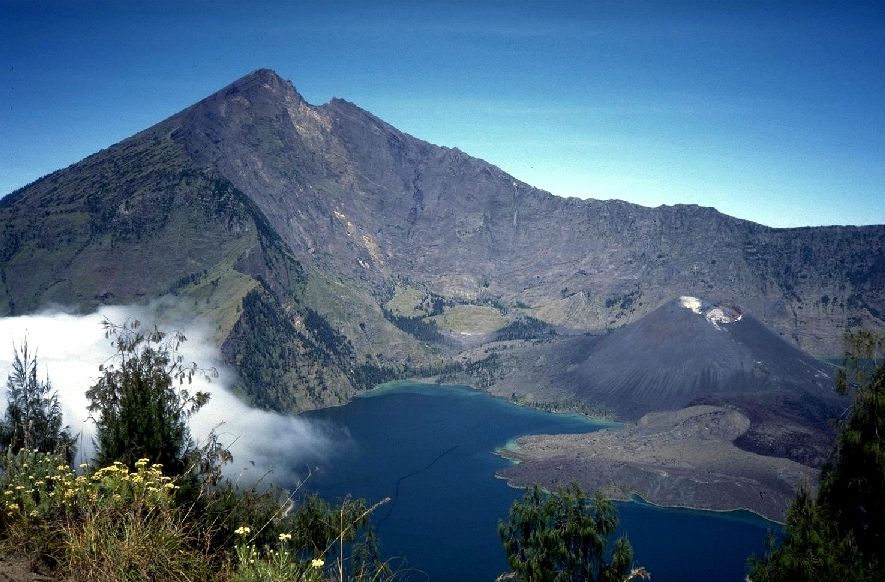
Tourist that visited to mount Rinjani, (3.726 m above sea surface) in Lombok Island, NTB, increase. During 4 months on 2008 (April – July) recorded 5038 total tourist that visited to mount Rinjani tour object, 3.238 person among foreign tourist and 1800 local tourist. In comparison with tourist visit data in the same period on 2007 as much as 4477 person. During year 2007 (January - December) total tourist that visited to mount Rinjani achieve 9.517 person; 5.065 person from outside Indonesia, 4.452 local tourist. Up to end 2008 estimated total tourist that visits to mount rinjani can achieve more than 10.000 people.Mount Rinjani tour object geographically located in three regencies; west Lombok, east Lombok, and middle Lombok. Ascent stripe begin from Sembalun, reachable during 4-5 hour using general transportation. From Sembalun Lawang atop mount Rinjani can be reached 7 hour by walk, temporary Sembalun Lawang - Segara Anak can be reached in 8-10 hour walk. Second choice, ascent stripe Senaru, reachable from Mataram about 3-4 hour with general transportation. Furthermore, Senaru to Segara Anak is about 7-10 hour by foot.

Tourists that visit mount Rinjani can enjoy various interesting tour object, as in Senaru, one of ascent gate. At Senaru, there is a culture village and unique 2 levels waterfall, called “Sedang Gila”, 25 meters tall, and “Tiu Kelep”. There also Sweet-Orange “Jeruk Manis” waterfall with height 30 meters in Kembang Kuning village. At location also found various kinds of fauna, like black monkey (Tracyphitecusauratus Cristatus) and bald eagle.

At the top of mountain Rinjani we can enjoy natural beauty, or fishing at Lake Segara Anak (2.010 dpi). There is also hot water source, believed to give healthy if we bathe with the water.

Still many interesting tour objects and beautiful scenery, flora and fauna at mount Rinjani. This area is proposed to be the first “Geo Park” in Indonesia, and therefore the second in Asia after Lengkawi Island in Malaysia. Well, let’s see the development

Mosque Float Red Sea


Jeddah (also spelled Jiddah, Jidda, or Jedda; Arabic: جدّة Ǧiddah) is a Saudi Arabian city located on the coast of the Red Sea and is the major urban center of western Saudi Arabia. It is the largest city in Makkah Province, and the second largest city in Saudi Arabia after the capital city, Riyadh. The population of the city currently stands at over 3.4 million. It is considered the commercial capital of Saudi Arabia and the wealthiest city in the Middle East and western Asia. Jeddah is the principal gateway to Mecca, Islam's holiest city, which able-bodied Muslims are required to visit at least once in a lifetime.

Floating Mosque in Jeddah is one of the most loved and visited sightseeing spots in the city of Jeddah. Jeddah is a classic mix of ancient with modern which is finely evident in its majestic architectures and buildings. The location of Jeddah on the coast of the Red Sea and the beaches subsequently formed makes it a favored travel destination of the tourists.Floating Mosque in Jeddah is one of the sacred sites in the city. The mosque is placed just next to the Red Sea which gives the impression that the mosque is floating in water. It is henceforth named the Floating Mosque. Due to the shimmering white color of the mosque it is also referred as the White Mosque. The mosque is located close to the center of Jeddah. The interior of the mosque is beautifully decorated. The mosque has all the modern facilities like the latest technology based sound systems. For the winter season the mosque also has the provision of hot shower. The Floating Mosque at Jeddah is a landmark of the city and is frequented by numerous tourists round the year from across the world. Floating Mosque in Jeddah bears testimony of the religion of Islam in Saudi Arabia. It is one of the marvelous sacred destinations in Jeddah. The architectural beauty with the huge decorated prayer space and the elegant rooftop gives a unique semblance to the mosque. A soothing ambiance is created inside the mosque. The serene ambiance in the interior of the mosque helps in meditating during the prayer. Not only the Muslims but people from all religions across the globe make it a point to visit the Floating Mosque in Jeddah at least once during their stay at the city.

Bogor Botanical Garden


Bogor Botanical Garden

Bogor can be said as the suburb of Jakarta city located 60 kms south of Jakarta. The city has a very nice weather with very famous Botanical Garden called Bogor Botanical Garden. The park has more than 15.000 species from world wide. Bogor has also Taman Safari, as beautiful panorama as Bogor Botanical Garden, the park has become very popular sightseeing place for people from Jakarta and Bandung, or even foreign tourists. The area between Bogor and the Puncak Pass is believed to be the water reservoir of Jakarta city with it's forever green. Today dozen of villas are scattered around the area up to the Puncak which is become the most sought week-end overnight hide away. Puncak Pass is well known from Dutch era of 19th century as the place for tea estate with magnificent green plateau views. Today the tea plantation is still managed well by the company belong to the state called Perkebunan Enterprise. Here you will see the pick-up of young tea leaves, processing, and and even taste the original tea produced locally.

The area around Puncak which is often reffered as Puncak Pass is the mian route from Jakarta to Central and East Java. The route from Bandung to Jakarta via Bogor is the most beautiful natural view that one could enjoy in Java after natural beauties such as Mount Bromo and mount Ijen in East Java. This area is one of the highlight of what is called Java Overland tours starting from Jakarta to the eaterntip of Java island. The area from Bogor to Cisarua town has been a problem to the city of Jakarta because most of the green areas are now taken by investors to build villas, recreations and hotels. This project has caused the hygroscopic potential of the area decreasing steadily and every rainy season causing great flood in the city of Jakarta.

Kamis, 30 April 2009

BALI


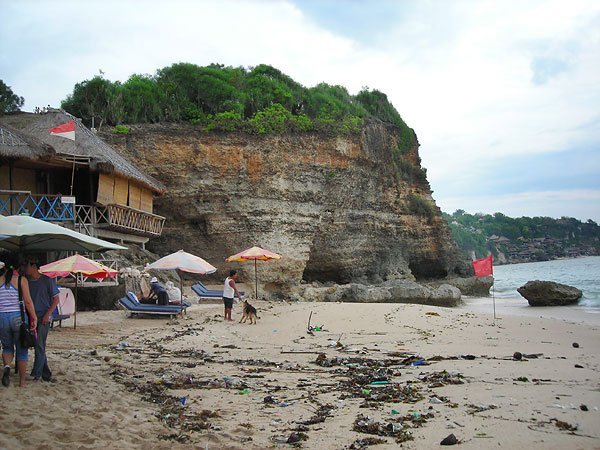
I didn’t know until now that Bali is blessed with some internationally competitive beaches. Due to its natures of its volcano origin, most popular beaches in Bali are of black or gray sand with sandy waters with either no waves at all or strong currents, making it a strange experience when swimming there.
The only almost-white beaches I knew so far were Nusa Dua and Sanur, both either very shallow or with almost no waves and lots of dirt and old plastic bags in the water. Kuta/Legian is nice to swim at, but the sand is gray and you really have to watch out for rip-currents or waves that can drag you out to sea. Every few weeks tourists or locals alike drown here, most recently 3 Balinese school boys around 12-14 years of age.

Kamis, 23 April 2009

Acropolis of Athens


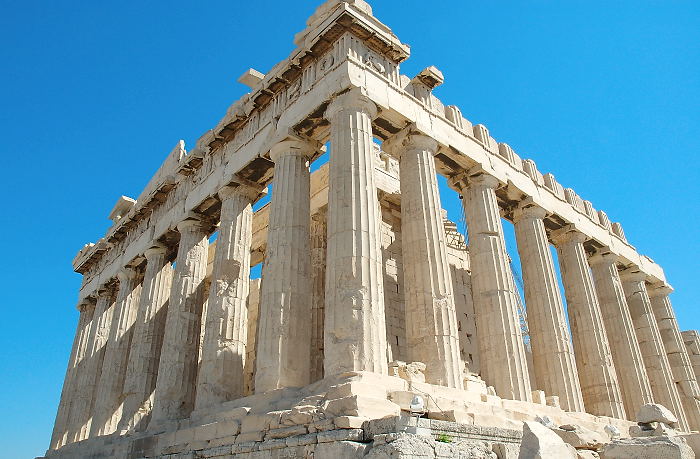
While the earliest artifacts date to the Middle Neolithic era, there have been documented habitations in Attica from the Early Neolithic (6th millennium BC). There is little doubt that a Mycenaean megaron stood upon the hill during the late Bronze Age. Nothing of this megaron survives except, probably, a single limestone column-base and pieces of several sandstone steps. Soon after the palace was built a Cyclopean massive circuit wall was built, 760 meters long, up to 10 meters high, and ranging from 3.5 to 6 meters thick. This wall would serve as the main defense for the acropolis until the fifth century. The wall consisted of two parapets built with large stone blocks and cemented with an earth mortar called emplekton. The wall follows typical Mycenaean convention in that it followed the natural contour of the terrain and its gate was arranged obliquely, with a parapet and tower overhanging the incomers' right-hand side, thus facilitating defense. There were two lesser approaches up the hill on its north side, consisting of steep, narrow flights of steps cut in the rock. Homer is assumed to refer to this fortification when he mentions the "strong-built House of Erechtheus" (Odyssey 7.81). At some point before the thirteenth century an earthquake caused a fissure near the northeastern edge of the acropolis. This fissure extended some thirty five meters to a bed of soft marl in which a well was dug. An elaborate set of stairs was built and the well was used as a protected source of drinking water during some portion of the Mycenaean period, as it was invaluable in times of siege.